What CRC Actually Reviews
CRC doesn’t just check if payroll runs.It analyses how your system behaves in practice - where risk actually lives.
Payroll Integrity Signals
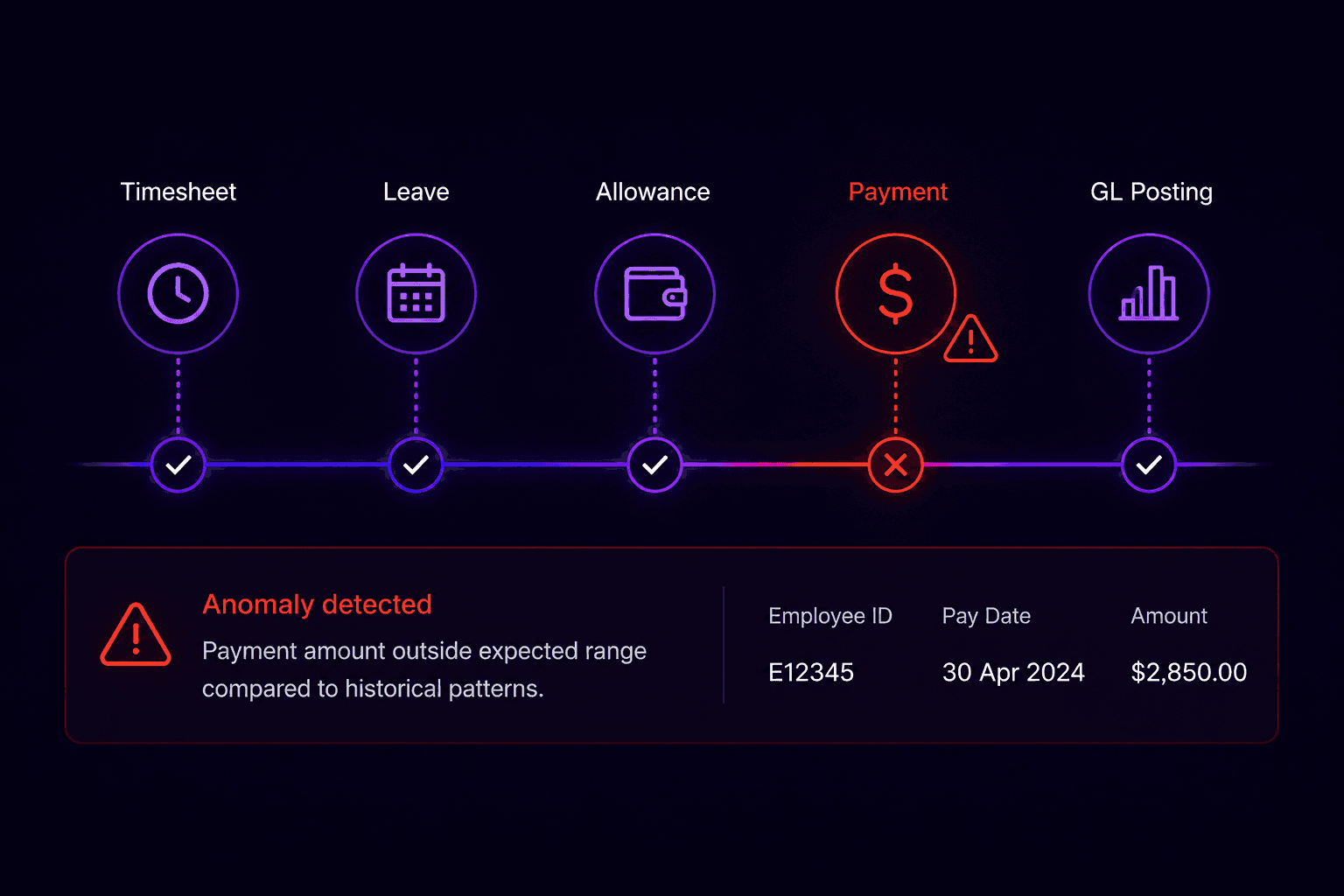
Payroll data can appear correct at a high level while inconsistencies, sequencing issues, and unusual transactions quietly accumulate underneath. CRC analyses payroll events, leave activity, allowances, and payment behaviour to identify patterns that may indicate payroll, process, or configuration risk.
Rather than relying on isolated checks, CRC looks for integrity signals across connected payroll activities — helping surface anomalies that may otherwise go unnoticed during day-to-day operations. This provides greater visibility into unusual payment behaviour, inconsistent payroll treatment, sequencing anomalies, and cross-record mismatches that may warrant further investigation.
ANOMALY DETECTION
PAYROLL EVENT REVIEW
SEQUENCING CHECKS
CROSS-RECORD CONSISTENCY
CONFIGURATION RISK SIGNALS
PAYROLL INTEGRITY ANALYSIS
Leave & Accruals
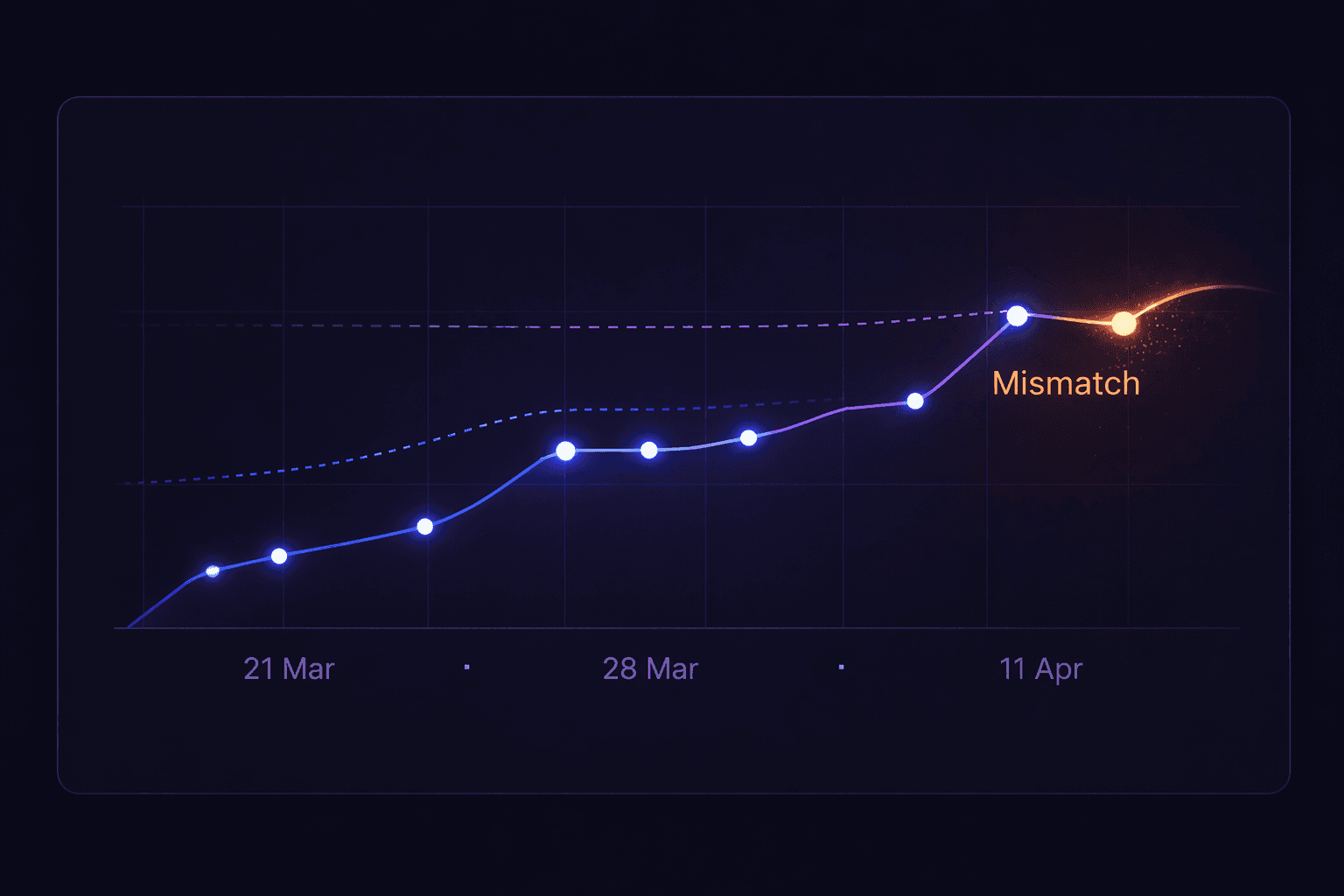
Leave balances and accruals should behave consistently over time—but small discrepancies can build unnoticed across pay cycles.
CRC analyses how leave is accrued, adjusted, and used, identifying mismatches between expected and actual behaviour.
These discrepancies can result in payroll errors such as incorrect leave balances, understated liabilities, or employee disputes over time.
ACCRUAL CALCULATION VALIDATION
BALANCE RECONCILIATION CHECKS
LEAVE USAGE ANALYSIS
MISMATCH DETECTION OVER TIME
LIABILITY EXPOSURE IDENTIFICATION
CONSISTENT ACCRUAL BEHAVIOUR
Cross-System Consistency
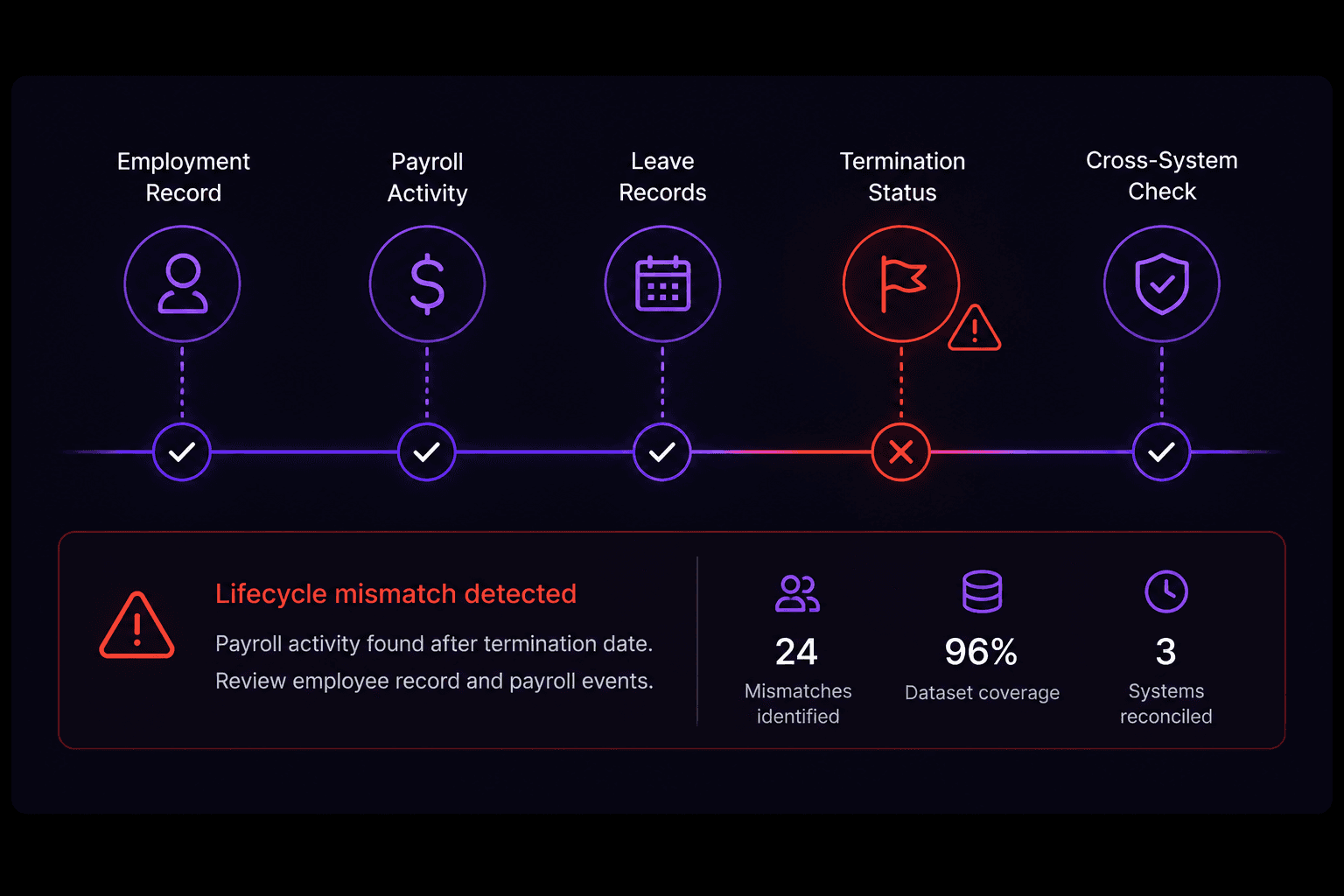
Payroll risks are not always caused by a single incorrect transaction. Many issues emerge when employee records, payroll activity, leave data, and lifecycle events no longer align consistently across systems and datasets.
CRC analyses relationships between connected payroll records to identify mismatches, sequencing inconsistencies, and integrity gaps that may indicate process weaknesses or incomplete payroll handling. This helps surface situations where payroll activity continues after termination, leave records conflict with employment status, or linked datasets no longer reconcile as expected.
By reviewing payroll data as an interconnected operational system rather than isolated transactions, CRC provides stronger visibility into hidden inconsistencies that can quietly increase payroll and governance risk over time.
LIFECYCLE MATCHING
CROSS-DATASET RECONCILIATION
SEQUENCING VALIDATION
EMPLOYMENT STATUS CHECKS
ORPHAN RECORD DETECTION
PAYROLL INTEGRITY REVIEW
Termination Handling
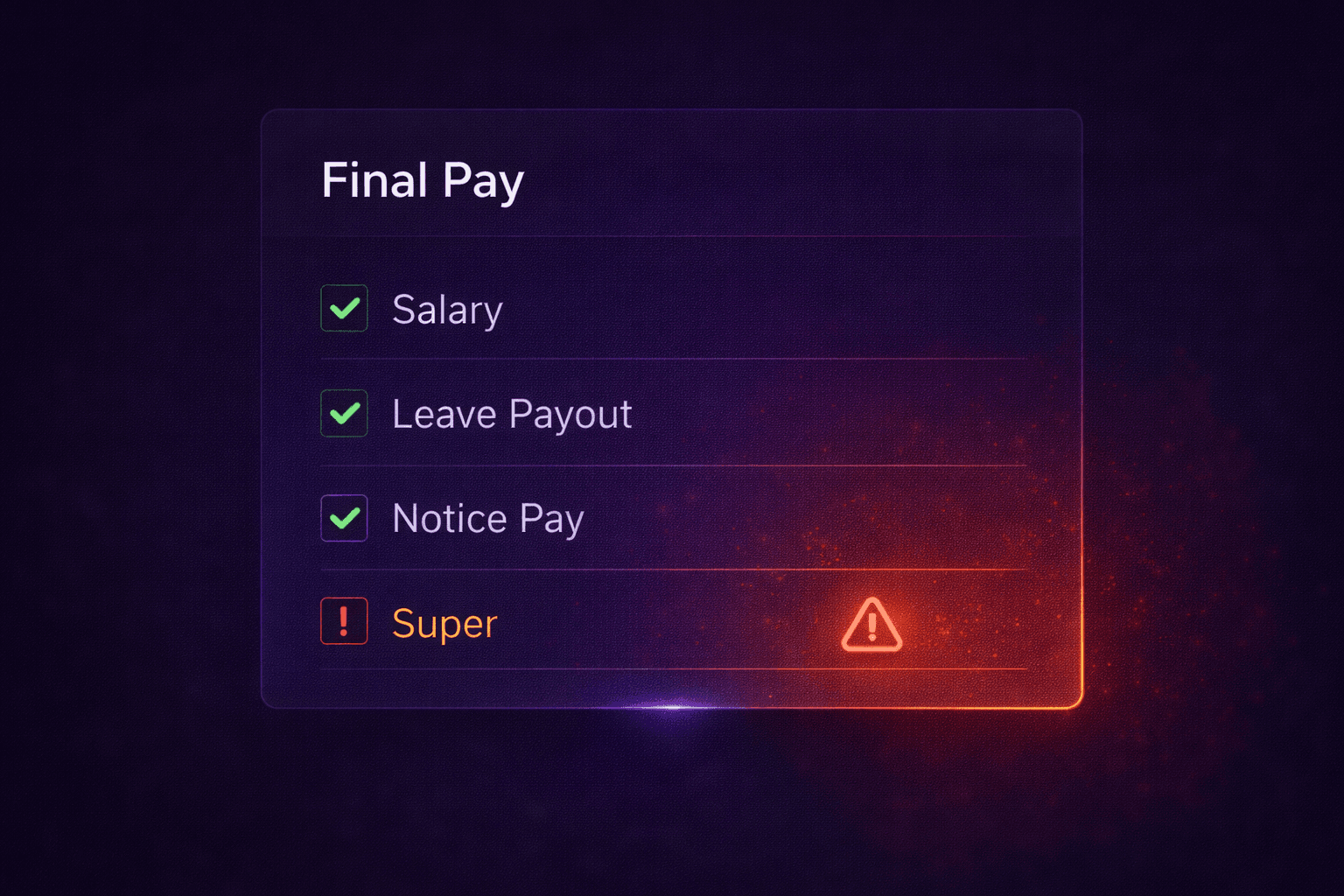
Final pay calculations must be handled accurately—but timing, sequencing, and missing components can introduce risk.
CRC reviews termination processing, including final pay, leave payouts, and statutory obligations.
This identifies payroll errors where payments are incomplete, delayed, or incorrectly calculated.
FINAL PAY VALIDATION
LEAVE PAYOUT CALCULATION CHECKS
NOTICE & ENTITLEMENT REVIEW
TIMING & SEQUENCING ANALYSIS
MISSING OR INCOMPLETE PAY EVENTS
TERMINATION PROCESS CONSISTENCY
How CRC Works
A simple, structured process designed to uncover hidden payroll risks - quickly and clearly.
Provide Payroll Data
Get started in minutes by securely sharing a targeted payroll export. No integrations, no system access, and no disruption to your existing payroll processes.
CRC works with a focused subset of your payroll data to identify potential payroll errors, inconsistencies, and early risk signals — without requiring sensitive or full-system access.
CRC is designed to work with the data you already have — nothing more.
NO SYSTEM ACCESS REQUIRED
STANDARD PAYROLL EXPORTS
TARGETED PAYROLL DATA
NO SENSITIVE DATA REQUIRED
SECURE FILE SHARING
FAST TO START
Data Analysis & Validation
CRC validates, maps, and structures your payroll data before any analysis begins — ensuring findings are based on clean, reliable inputs, not assumptions.
Inconsistent formats, missing fields, and data gaps are identified early — because poor payroll data quality can lead to hidden payroll errors and inaccurate outcomes.
This step creates a consistent foundation across your dataset, enabling meaningful comparisons and accurate detection of payroll discrepancies and risks.
PAYROLL DATA VALIDATION
STRUCTURED PAYROLL DATA MAPPING
INCONSISTENCY DETECTION
PAYROLL DATA GAP IDENTIFICATION
STANDARDISED DATA MODEL
ANALYSIS-READY OUTPUT
Risk Detection Engine
CRC applies a structured, rules-based approach to identify payroll errors, inconsistencies, and hidden risks that may not be visible during normal payroll processing.
Rather than relying on surface-level checks, the engine evaluates patterns across employees, pay events, and time — surfacing issues that often go unnoticed within standard payroll processes.
Each signal is grounded in defined logic, ensuring findings are consistent, explainable, and repeatable across your payroll data.
RULES-BASED PAYROLL ANALYSIS
CONSISTENT LOGIC APPLICATION
CROSS-EMPLOYEE COMPARISONS
REPEATABLE RESULTS
PAYROLL ANOMALY DETECTION
PATTERN IDENTIFICATION
Findings & Evidence
Each payroll issue identified by CRC is clearly defined, supported by data, and presented with full context — so you can understand what happened, where, and why.
Rather than vague alerts, findings are structured with a clear explanation of the issue, its impact, and when it occurred — giving you confidence in the results.
Supporting evidence is included for every finding, ensuring payroll errors and inconsistencies are transparent, traceable, and easy to validate.
CLEAR PAYROLL ISSUE DEFINITIONS
SUPPORTING PAYROLL DATA EVIDENCE
FULL CONTEXT PROVIDED
TRACEABLE FINDINGS
EXPLAINABLE RESULTS
AUDIT-READY OUTPUT
Executive Risk Summary
CRC distils detailed findings into a clear, high-level view of your payroll risk profile — so you can quickly understand where issues are building and what matters most.
Key payroll risks are summarised, prioritised by severity, and presented in a way that’s easy to interpret — without requiring deep technical or payroll expertise.
This provides stakeholders with a concise view of payroll errors, inconsistencies, and risk exposure — helping you focus attention where it’s needed most.
HIGH-LEVEL PAYROLL RISK OVERVIEW
SEVERITY-BASED PRIORITISATION
CLEAR, NON-TECHNICAL LANGUAGE
STAKEHOLDER-READY OUTPUT
FOCUSED PAYROLL RISK SUMMARY
EASY TO INTERPRET
Actionable Next Steps
CRC goes beyond identifying payroll errors and risks by providing clear, practical guidance on what to do next.
Each finding is supported with recommended actions — helping you prioritise, investigate, and resolve payroll errors and inconsistencies with confidence.
This ensures insights don’t just sit in a report, but translate into meaningful improvements across your payroll processes.
CLEAR PAYROLL ACTIONS
PRIORITISED NEXT STEPS
PRACTICAL GUIDANCE
PAYROLL ISSUE RESOLUTION
IMPLEMENTATION SUPPORT
CONFIDENCE TO ACT
What You Actually Receive
A structured report that shows where risks exist, why they matter, and what to do about them. Designed to surface issues that don’t break payroll - but quietly build risk over time.
Risk Summary Overview
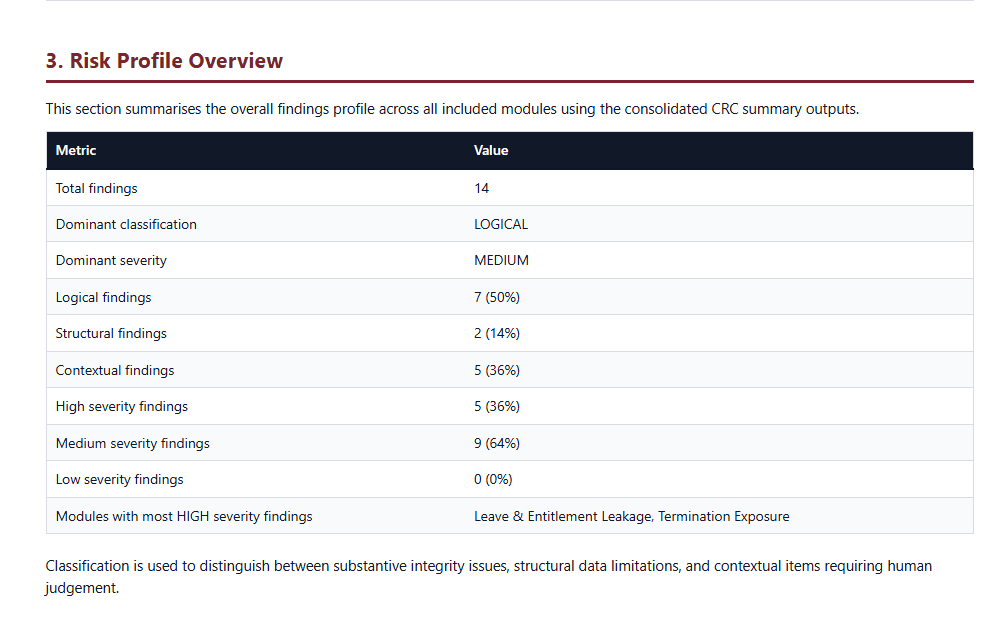
The Risk Summary Overview provides a high-level, executive view of your payroll risk profile — bringing together key findings into a clear, structured summary.
It highlights where payroll risks are concentrated, how severe they are, and where patterns are emerging across your payroll data.
This allows you to quickly understand where payroll errors, inconsistencies, and risk exposure exist — without needing to review detailed technical findings.
See where risk is building — before it becomes a problem.
EXECUTIVE-LEVEL PAYROLL RISK VIEW
SEVERITY & PRIORITY HIGHLIGHTING
CONSOLIDATED PAYROLL FINDINGS SUMMARY
PAYROLL RISK PATTERN IDENTIFICATION
CROSS-MODULE RISK INSIGHT
CLEAR, NON-TECHNICAL OUTPUT
Sample Findings
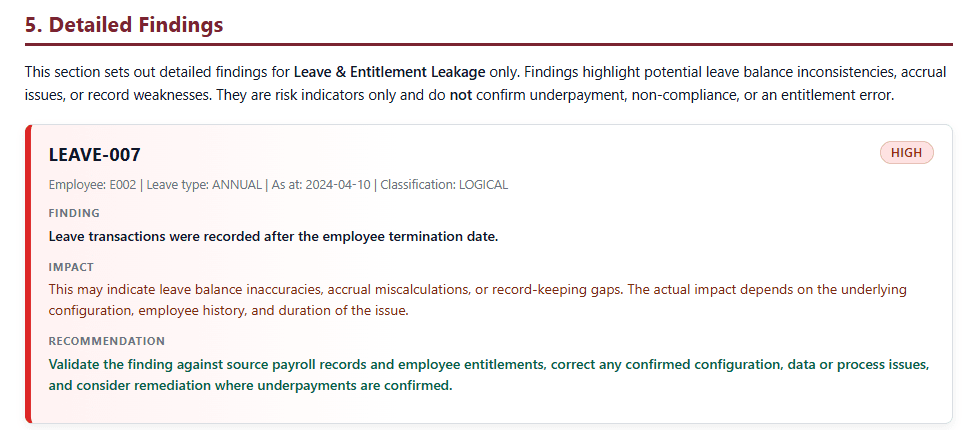
Sample Findings show real payroll issues identified from your payroll data — highlighting where errors, inconsistencies, and risks exist in practice.
Each finding is clearly explained, supported by data, and linked to its underlying cause — giving you a clear view of what happened, why it matters, and where to investigate.
These are not assumptions or theoretical checks — they are actual payroll errors and inconsistencies detected within your system.
Real issues, detected in your payroll — not just theoretical checks.
REAL PAYROLL ISSUE IDENTIFICATION
CLEAR FINDING EXPLANATIONS
CONTEXT & IMPACT INCLUDED
DATA-BACKED PAYROLL EVIDENCE
ROOT CAUSE VISIBILITY
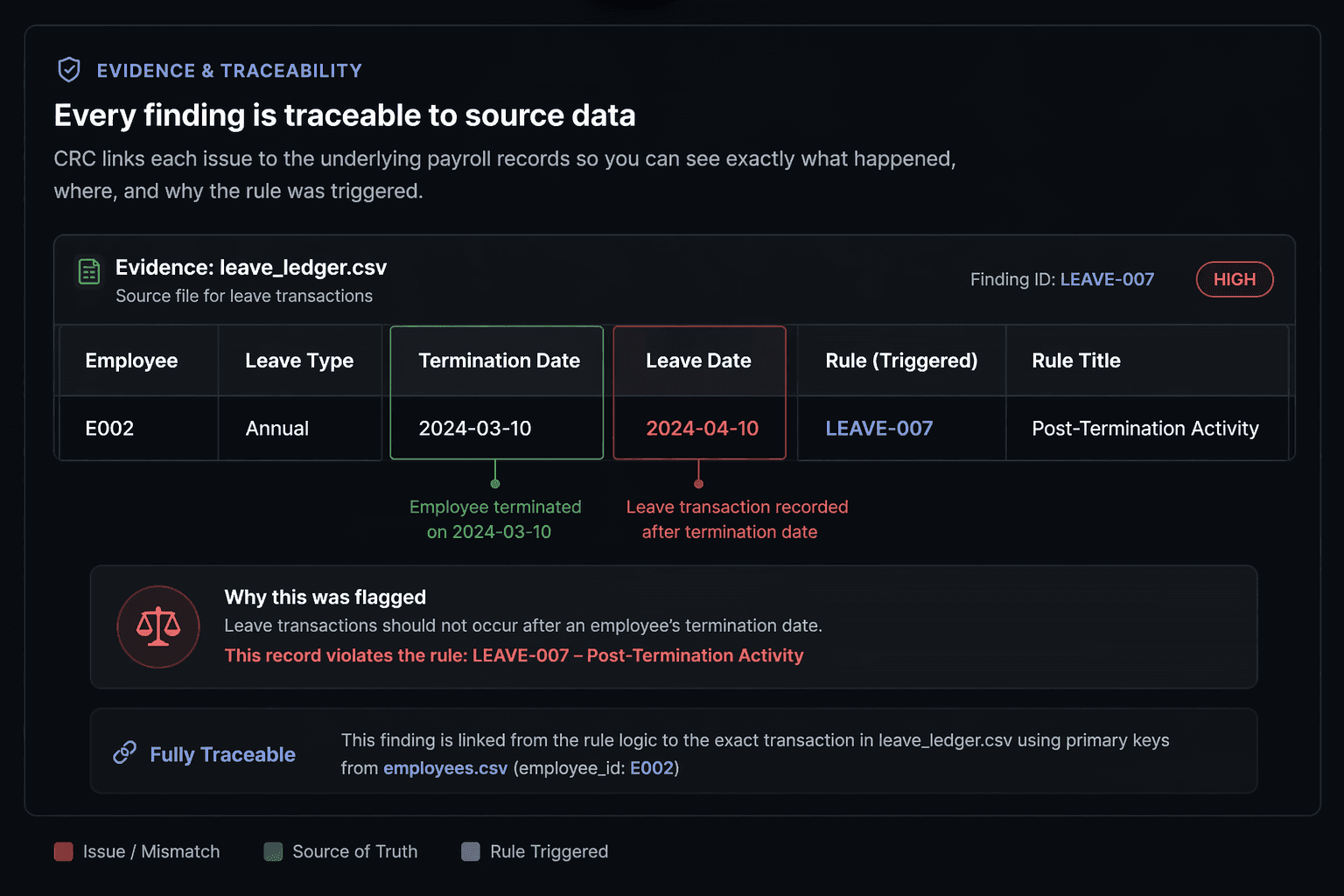
Evidence & Traceability
Every finding in the CRC report is supported by structured, traceable evidence drawn directly from your payroll data.
CRC shows exactly how and why each payroll issue was identified — linking outcomes back to source records, rules, and system behaviour.
There is no “black box” — payroll errors and inconsistencies are fully transparent, traceable, and supported by clear underlying data.
Every finding can be traced — back to the exact source.
PAYROLL DATA TRACEABILITY
CLEAR EVIDENCE LINKAGE
RULE-TO-OUTCOME TRANSPARENCY
RECORD-LEVEL PAYROLL VALIDATION
AUDIT-READY OUTPUT
Example of how findings are traced back to source data

Actionable Next Steps
Each CRC report includes clear, practical guidance for every finding — outlining what to validate, where to investigate, and how to address identified payroll issues.
Recommended actions are tailored to the specific payroll errors and inconsistencies identified — helping you prioritise, investigate, and resolve issues with confidence.
CRC turns findings into structured, actionable next steps — so you can move from insight to resolution without guesswork.
Know what to fix — and where to start.rns findings into structured, actionable next steps — so you can move from insight to resolution without guesswork.
CLEAR PAYROLL REMEDIATION GUIDANCE
VALIDATION & INVESTIGATION STEPS
PRIORITISED ACTIONS
CONTEXT-AWARE RECOMMENDATIONS
PRACTICAL, NON-TECHNICAL OUTPUT
Where Payroll Risk Actually Lives
The issues that don’t break payroll immediately - but quietly create risk across rules, timing, and system behaviour.
Drift
Drift occurs when payroll behaviour gradually changes over time — without a clear trigger or obvious failure.
Small configuration updates, manual adjustments, and evolving payroll rules can quietly shift how payroll is calculated across pay runs and employees.
These changes rarely cause immediate errors, but over time can lead to payroll inconsistencies, incorrect payments, and growing risk exposure.
What appears stable on the surface can slowly move away from expected outcomes — often without being detected.
Payroll doesn’t break — it drifts.
PAYROLL CHANGE OVER TIME DETECTION
CONFIGURATION DRIFT ANALYSIS
PAY RUN TREND COMPARISON
UNEXPLAINED PAYROLL VARIATION IDENTIFICATION
BASELINE VS CURRENT BEHAVIOUR
ACCUMULATING DISCREPANCY TRACKING


Misalignment
Misalignment occurs when payroll rules are configured correctly — but are not applied consistently across employees, roles, or pay runs.
Variations in configuration, classification, or rule application can lead to different payroll outcomes under the same conditions.
These issues are often subtle and difficult to detect, but can result in payroll inconsistencies, incorrect payments, and employee-level discrepancies.
When the same payroll rules produce different results, something in the system is misaligned.
Same rules — different outcomes.
CROSS-EMPLOYEE PAYROLL COMPARISON
INCONSISTENT RULE APPLICATION
PAY RATE & ALLOWANCE VARIATION
CLASSIFICATION MISMATCH DETECTION
UNEVEN PAYROLL OUTCOME IDENTIFICATION
RULE APPLICATION VALIDATION
Desynchronisation
Desynchronisation occurs when payroll events are processed at the wrong time, in the wrong sequence, or out of sync with each other.
Delays, sequencing gaps, or misaligned updates can cause payroll calculations to be applied incorrectly across pay runs.
These issues are often subtle and difficult to detect, but can result in payroll inconsistencies, incorrect payments, and compounding errors over time.
When timing slips, payroll outcomes no longer reflect what actually happened.
If events fall out of sync, outcomes fall apart.
PAYROLL EVENT TIMING VALIDATION
SEQUENCE & ORDER CHECKS
DELAY DETECTION BETWEEN ACTIONS
TERMINATION & FINAL PAY TIMING
ACCRUAL & PAYMENT ALIGNMENT
OUT-OF-SYNC PAYROLL PROCESS IDENTIFICATION


Fragmentation
Fragmentation occurs when payroll data, rules, and processes are spread across disconnected systems, files, or structures.
When these components don’t align, it becomes difficult to trace payroll outcomes, validate results, and maintain consistency across your payroll.
These gaps often lead to payroll inconsistencies, duplicated or missing data, and reduced visibility into how payroll is calculated.
Disconnected systems create disconnected outcomes — increasing risk across your payroll.
When payroll is fragmented, risk multiplies.
CROSS-SYSTEM PAYROLL DATA CONSISTENCY
DATA GAP & DUPLICATION DETECTION
DISCONNECTED PROCESS IDENTIFICATION
PAYROLL RECORD-KEEPING INTEGRITY CHECKS
TRACEABILITY ACROSS SOURCES
STRUCTURAL PAYROLL CONSISTENCY VALIDATION
Where Payroll Risk Actually Lives
The issues that don’t break payroll immediately - but quietly create risk across rules, timing, and system behaviour.
Drift
Drift occurs when payroll behaviour gradually changes over time — without a clear trigger or obvious failure.
Small configuration updates, manual adjustments, and evolving payroll rules can quietly shift how payroll is calculated across pay runs and employees.
These changes rarely cause immediate errors, but over time can lead to payroll inconsistencies, incorrect payments, and growing risk exposure.
What appears stable on the surface can slowly move away from expected outcomes — often without being detected.
Payroll doesn’t break — it drifts.
PAYROLL CHANGE OVER TIME DETECTION
CONFIGURATION DRIFT ANALYSIS
PAY RUN TREND COMPARISON
UNEXPLAINED PAYROLL VARIATION IDENTIFICATION
BASELINE VS CURRENT BEHAVIOUR
ACCUMULATING DISCREPANCY TRACKING
Misalignment
Misalignment occurs when payroll rules are configured correctly — but are not applied consistently across employees, roles, or pay runs.
Variations in configuration, classification, or rule application can lead to different payroll outcomes under the same conditions.
These issues are often subtle and difficult to detect, but can result in payroll inconsistencies, incorrect payments, and employee-level discrepancies.
When the same payroll rules produce different results, something in the system is misaligned.
Same rules — different outcomes.
CROSS-EMPLOYEE PAYROLL COMPARISON
INCONSISTENT RULE APPLICATION
PAY RATE & ALLOWANCE VARIATION
CLASSIFICATION MISMATCH DETECTION
UNEVEN PAYROLL OUTCOME IDENTIFICATION
RULE APPLICATION VALIDATION
Desynchronisation
Desynchronisation occurs when payroll events are processed at the wrong time, in the wrong sequence, or out of sync with each other.
Delays, sequencing gaps, or misaligned updates can cause payroll calculations to be applied incorrectly across pay runs.
These issues are often subtle and difficult to detect, but can result in payroll inconsistencies, incorrect payments, and compounding errors over time.
When timing slips, payroll outcomes no longer reflect what actually happened.
If events fall out of sync, outcomes fall apart.
PAYROLL EVENT TIMING VALIDATION
SEQUENCE & ORDER CHECKS
DELAY DETECTION BETWEEN ACTIONS
TERMINATION & FINAL PAY TIMING
ACCRUAL & PAYMENT ALIGNMENT
OUT-OF-SYNC PAYROLL PROCESS IDENTIFICATION
Fragmentation
Fragmentation occurs when payroll data, rules, and processes are spread across disconnected systems, files, or structures.
When these components don’t align, it becomes difficult to trace payroll outcomes, validate results, and maintain consistency across your payroll.
These gaps often lead to payroll inconsistencies, duplicated or missing data, and reduced visibility into how payroll is calculated.
Disconnected systems create disconnected outcomes — increasing risk across your payroll.
When payroll is fragmented, risk multiplies.
CROSS-SYSTEM PAYROLL DATA CONSISTENCY
DATA GAP & DUPLICATION DETECTION
DISCONNECTED PROCESS IDENTIFICATION
PAYROLL RECORD-KEEPING INTEGRITY CHECKS
TRACEABILITY ACROSS SOURCES
STRUCTURAL PAYROLL CONSISTENCY VALIDATION
Seen how it works — now see it on your own payroll.
Start with a limited free pilot and uncover real risks, inconsistencies, and next steps — using your own data.
Limited free pilot available